


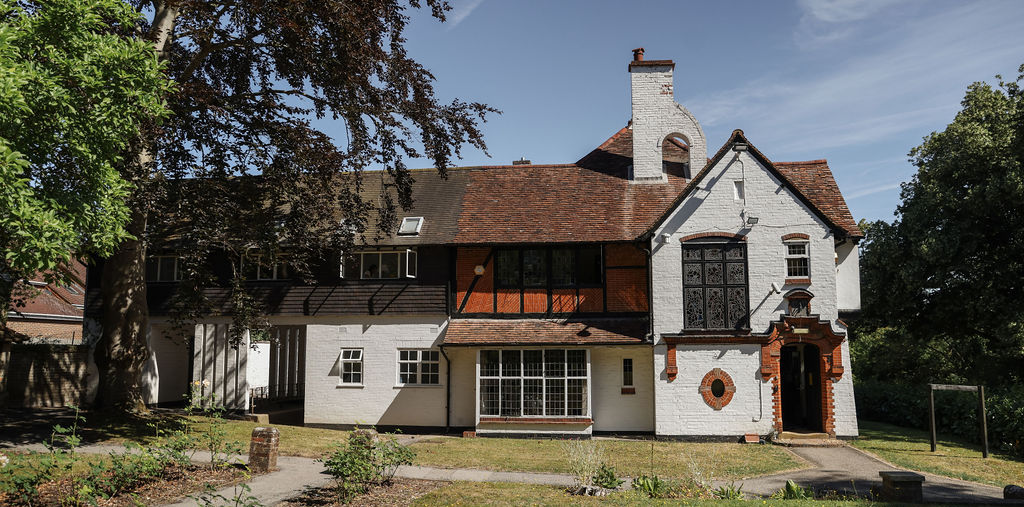
RED GABLES
History
In the early 20th century, Red Gables was renowned in the small village of Harpenden as the residence of the respected artist Francis Owen Salisbury, his wife Alice Maude and their twin daughters Sylvia and Monica. In those days, the population of Harpenden was less than 6,000, and included a number of large, well-endowed families. Many of the important residents had their portraits painted by Frank Salisbury.
Frank had the house built in 1906 and lived in it until 1913. Here he painted ‘Tales of Enchantment’ (right): his wife reading to her children in the dining room, which remains as it was in Frank’s day.
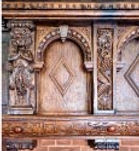
On the beautiful carved mantlepiece (right) you can see his initials on the left (FOS). On the right of the mantlepiece are the initials of his wife (AMS) Frank was known internationally for his VIP portraits, including kings and queens, American presidents, captains of industry on both sides of the Atlantic, Mussolini, and even popular figures such as Richard Burton. The King personally commissioned him to record the great national events of the first half of the 20th century, including his coronation, his 25-year Jubilee and the parade and ceremony of the Burial of the Unknown Warrior.
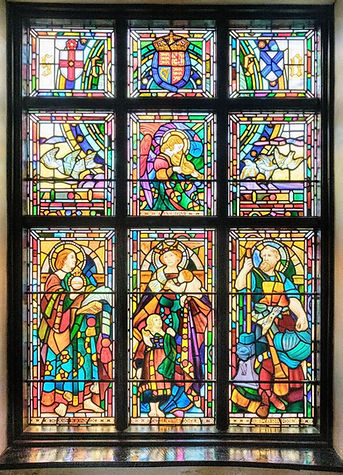
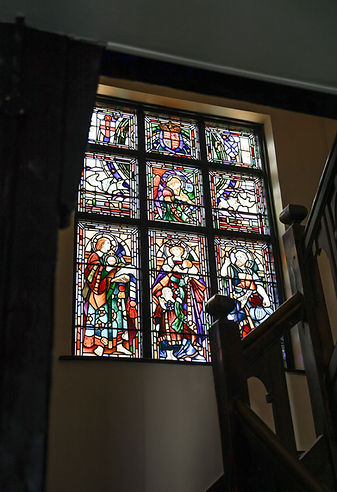
And that stained glass window in Red Gables?
Frank’s artistic career started with his apprenticeship, aged 15, to his brother James, who ran a stained-glass workshop in St Albans. His stained-glass legacy in Harpenden includes the main windows in the Methodist church, and in the chapel at the Oval, formerly a National Children’s Home. He was responsible for four major windows in Wesley’s chapel in London. The window in Red Gables was designed to showcase his work in this field. What you see is a copy. The original was stolen from the house and never found.
Frank's stained-glass windows always had a symbolic, spiritual significance. He called this one 'Religion, Motherhood and Honest Labour'
What about the history of the house, its position, architect and later owners?
The site in Leyton Road used to be Chapel Row, a group of cottages that included the earliest Methodist chapel in Harpenden: appropriate, as Frank, indeed the entire Salisbury family, were devout Methodists. The cottages were demolished, and the site was bought at auction in September 1906 by Frank for £450. His brother Eustace designed the house to Frank’s specification: the most important feature being the double height room (now the shared office space) as his studio. He needed the space to create his huge ‘pageant’ pictures.
Eustace Salisbury designed numerous houses in Harpenden, including several nearby, also in gabled style, white with dark beams. Little Gables and the Old Coach House in Leyton Road are two attractive examples. Little Gables was the studio in which Frank’s stained-glass work was created. Both houses are decorated with small lights framing fragments of stained glass.
In 1913 Frank bowed to the need to be close to his important clientele – such as King George V. He moved to a rented house in St John’s Wood, eventually buying a plot on Hampstead Heath and building a huge house (sometimes sneeringly called ‘Hollywood Tudor’) on West Heath Road. The house was called Sarum Chase and was designed by his nephew Vyvyan. Frank lived there for the rest of his life. He did not lose touch with Harpenden, however, and is buried in the churchyard of St Nicholas in the town centre.

After Frank's departure
1913
The Hogg family
It was leased to the Hogg family for 21 years in December 1913. The Hogg family is known in Harpenden for different and indeed heroic reasons. Their son, George Ayling Hogg, was born in Red Gables in 1915. Schooled at St George’s in Harpenden, then at Cambridge University, he went to China in 1938 at the age of 23 during the Sino-Japanese war. In 1942 he became headmaster of a village technical school, from which he rescued a large group of children from the invading Japanese forces by taking them through the mountains. He is revered throughout China for his heroism.
1921
The Lawes Trust
The Lawes Trust bought Red Gables on 5th April 1921. The Hogg family remained as tenants until 1929, when they moved to ‘Wayfarings’, just a little further down Leyton Road. Wayfarings was also designed by Eustace Salisbury, in a more extravagant style than his other nearby houses.
Red Gables has subsequently been used for many purposes by the Lawes Trust. As a contemporary noted in 1930: ‘… Red Gables now belongs to the Laboratory and is used as offices and the large room which was FOS’ studio is used as an assembly room and for parties’.
2025
The Harpenden Collective
In 2025 it has been refurbished to become the office collective you now see.